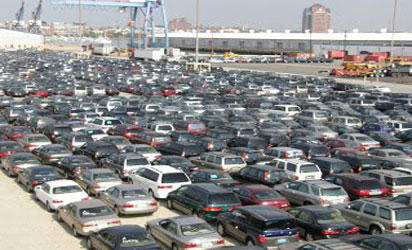
…as Customs seizes 870 smuggled vehicles worth N3.88bn in 15 months
By Efe Onodjae
Fresh revelations from stakeholders in the automobile and maritime sectors have identified high vehicle clearing costs, port delays, and freight charges as major reasons many Nigerians patronise neighbouring countries and resort to smuggling vehicles into the country.
This comes as statistics obtained from the Nigeria Customs Service (NCS) show that no fewer than 870 vehicles were seized between 2025 and the first quarter of 2026 over violations linked to importation and smuggling.
According to the Customs seizure report, a total of 160 seizures involving 870 vehicles were recorded during the period. The affected vehicles had a Cost, Insurance and Freight (CIF) value of N3.136 billion, while the total Duty Paid Value (DPV) stood at N3.88 billion.
Speaking in an interview with Vanguard, the National President of the Association of Motor Dealers of Nigeria (AMDON), Ajibola Adedoyin, said the major factor driving vehicle importers to neighbouring countries is the significant difference in clearing charges.
According to him, many importers prefer clearing vehicles in countries such as the Benin Republic before attempting to bring them into Nigeria because the duties are considerably lower.
“It is not far-fetched. The major reason is the amount they are going to pay for clearing. It is less in those neighbouring countries, and that is why they take that route. Port congestion and the time required to clear vehicles in Nigeria also contribute to the trend. Those are the three major things people consider.
But the principal factor remains the difference in the clearing duty amount. Every other thing comes after that,” he explained.
Although smuggling remains a risky venture, he noted that importers could lose millions of naira if intercepted by security agencies. “If someone invests N10 million or N20 million in a vehicle and it gets seized, wouldn’t it have been better to properly declare and clear it? The risk involved is very high,” he said.
Adedoyin noted that while smuggling can never be completely eliminated, the government can significantly reduce it by reviewing vehicle import duties.
“We have consistently advised government to bring down the cost of clearing vehicles. Doing so will discourage people from going to neighbouring countries to clear vehicles and then smuggle them into Nigeria,” he stated.
He further explained that many importers only consider the alternative route because the savings involved are substantial.
“If the difference is just N200,000 and your travel and logistics cost N120,000, it may not be worth it. But when the difference runs into N1 million or N2 million, many people see it as worthwhile, despite the risks,” he added.
Meanwhile, the Head of Research at the Sea Empowerment and Research Centre (SEREC), Eugene Nweke, said economic realities often influence business decisions.
“Every businessman wants to maximise profit. If tariffs are competitive and aligned with realities in the sub-region, vehicle smuggling will reduce significantly,” he stated.
He pointed to disparities in shipping costs, noting that ocean freight charges to Nigerian ports are often significantly higher than charges to ports in neighbouring countries. According to him, some shipping lines charge considerably less to destinations such as Cotonou and Ghana compared to Nigeria, making those ports more attractive to vehicle importers.