By Johnbosco Agbakwuru
ABUJA: The Presidency has said Governor Ademola Adeleke’s decision to support President Bola Tinubu’s re-election bid has undermined opposition efforts to use the Osun governorship election as a launching pad for a broader coalition against the All Progressives Congress, APC, ahead of the 2027 general elections.
Adeleke’s victory in the August 15 Osun governorship election initially provided the opposition with a new political talking point, the Presidency said. However, his subsequent declaration of support for Tinubu weakened the argument that the election represented a rejection of the President or his administration.
Tunde Rahman, Senior Special Assistant to the President on Media and Special Duties, said the Osun outcome was significant for reasons beyond the victory of the Accord Party candidate.
He argued that Adeleke’s re-election and his decision to support Tinubu had complicated efforts by opposition politicians to portray the result as evidence of a growing anti-Tinubu movement in the South-West.
Adeleke, who contested the election on the Accord Party platform, polled 511,067 votes to defeat the APC candidate, Asiwaju Bola Oyebamiji, popularly known as AMBO, who secured 444,815 votes.
Rahman said attempts by opposition forces to portray the victory as a product of a broader political alliance were undermined by Adeleke himself, who, according to him, made it clear that he had no working arrangement with any opposition party or coalition.
“Following his victory, an elated Governor Adeleke restated his earlier position to work for President Tinubu’s re-election in 2027. He promised to put everything into the task, including collaborating with the APC members in the state,” he said.
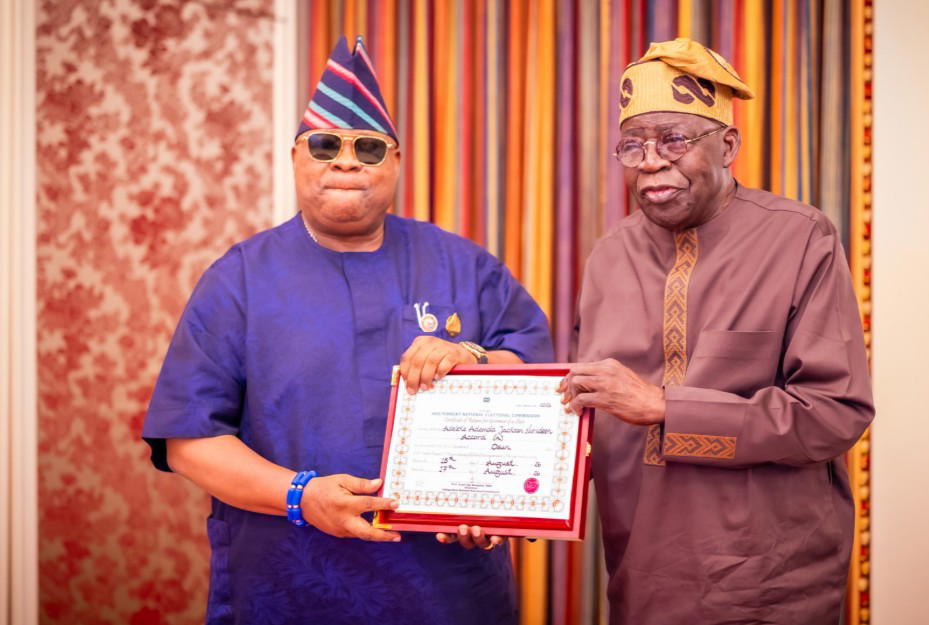
The governor subsequently reinforced the position during his August 20 visit to President Tinubu at the Presidential Villa, Abuja, where he presented his certificate of return.
During the meeting, Adeleke thanked the President for ensuring a free and fair election, while Tinubu congratulated him on his victory and urged him to embrace unity and reconciliation.
The President also advised the governor to broaden his political constituency and refrain from stigmatising his opponents.
The Presidency said the development had complicated the opposition’s attempt to turn the Osun result into a launching pad for the 2027 elections.
Former Vice President and presidential candidate of the African Democratic Congress, ADC, Alhaji Atiku Abubakar, and other opposition leaders had described the Osun outcome as evidence that Nigerians were seeking an alternative in 2027.
However, the Presidency argued that Adeleke’s position did not support such a sweeping interpretation.
It said the governor’s declared support for Tinubu, coming shortly after his re-election, demonstrated that the Osun contest should not be reduced to a referendum on the President or the Federal Government.
The Presidency also highlighted Tinubu’s decision to congratulate Adeleke before the election results were formally announced as a significant factor in interpreting the outcome.
At about 2 a.m. on Sunday, while the results were still being collated, Tinubu reportedly called Adeleke and congratulated him on his victory, telling him that the people of Osun had spoken and given him a mandate to lead the state for another four years.
Rahman said the call “changed the political calculus”, portraying Tinubu as “a dyed-in-the-wool democrat, a statesman and a father of all.”
He said the President’s action also reinforced the credibility of the electoral process by demonstrating that the Federal Government did not interfere with the outcome.
Given the political and institutional influence of the Federal Government, Rahman said Tinubu could have attempted to deploy federal power against Adeleke and his political structure but instead chose to respect the voters’ verdict.
The Presidency believes the posture could become politically significant as the 2027 contest intensifies, particularly in the South-West, where the APC has traditionally enjoyed considerable influence.
According to the Presidency, the Osun result should also be understood against the backdrop of local political dynamics rather than interpreted as an outright rejection of the APC or Tinubu.
Adeleke won 19 of the state’s 30 local government areas, including Ede North, Ede South, Osogbo, Ife Central, Iwo, Ejigbo, Ifelodun, Odo-Otin, Ila and Ayedaade.
Oyebamiji won 11 LGAs, including Ilesha East, Ife South, Boripe, Irepodun, Obokun and Olorunda.
While Adeleke secured 511,067 votes against Oyebamiji’s 444,815, the APC candidate garnered about 40 per cent of the total votes cast.
The 66,252-vote winning margin was also substantially higher than the 28,344-vote difference recorded between Adeleke and former Governor Adegboyega Oyetola in the 2022 election.
Rahman said the APC could point to local factors, including internal contradictions within the party and lingering controversies over the policies of previous administrations, as factors that shaped the outcome.
The opposition, he noted, would inevitably seek to interpret the election as a rejection of the Federal Government’s economic reforms, particularly policies that initially imposed significant hardship on Nigerians.
But he argued that the election was primarily a state contest in which candidates, local issues, party structures and voter preferences played decisive roles.
The Presidency believes the immediate implication of the Osun election is that it has effectively accelerated the 2027 political season.
Although the presidential campaign formally commenced on August 19, major political blocs are already interpreting the Osun result as an early indicator of voter sentiment.
For the opposition, the victory provides a psychological boost and a new political talking point.
However, Adeleke’s commitment to Tinubu’s re-election means the opposition cannot easily convert the Accord Party’s victory into a straightforward anti-APC or anti-Tinubu narrative.
The Presidency therefore sees the Osun outcome as both a warning and an opportunity for the ruling party: a warning that the South-West remains politically competitive and an opportunity to strengthen engagement with voters ahead of 2027.
With months to the presidential election, the political contest has effectively begun.
And while the opposition may have secured an important headline from Osun, the Presidency believes Adeleke’s decision to back Tinubu has denied it the broader political dividend it hoped to derive from the governor’s victory.